Aaaaaaaah the press.
Otherwise known as the standing barbell press, military press or overhead press. No matter what you call it, it's bar none the best way to develop pushing strength in the human upper body. In recent years the bench press has taken over as the official benchmark of human pushing strength. This is because the bench places the upper body in a more stable position making it easier to judge in competition. If you want to build real upper body strength nothing will do it quite like the press.
Thankfully, of all the exercises described in this series, the press is the easiest to teach over the internet.
The stance This part is largely up to you. You want your feet to be under your hips, from there play with width until you find something that is comfortable for you. Set the bar up on the rack to be about mid sternum height. When you pick up the bar you want your hips slightly tucked under just enough that you don't over arch your back. Keep your abs tight and your chest out and high kind of like as if you were walking along a beach full of ladies (or dudes if that's your thing).
Approach the bar Step up to the bar. Grab the bar with some chalk on your hands. When you pick the bar up, you want it resting along the upper part of your chest, on your upper pectorals. Elbows should be pointed down and slightly out in front of the bar. You want your wrists to be relatively straight and not cocked back from the weight of the bar. When you press, you want the weight of the bar to be directly over your wrists. Letting the weight cock your hands back at the wrists is an unstable position. You won't be able to push as mush weight and you will get sore after a while.
Now Press
From this position, all you have to do is push the bar overhead. Be careful not to dip at all through the knees, this is called hip drive and effectively turns the move into a push press. In order to avoid hip drive while pressing, I like to lock my knees out before pressing, effectively making it impossible to add hip drive to the movement.
The bar should track very close to your face. So close that you should just barely miss skinning your chin with the knurling in the center of the bar. As soon as the bar clears your head, push your head through so that the bar is in line with, or just behind your ears. Keep pushing up until you are fully locked out in the overhead position. That was a press
Now lower the bar back under control to your chest following the exact same path back down and repeat.
It's sure been a while hasn't it. Once again I must apologize for my lack of updates but I have been on a personal protest against most forms of modern technology. Therefore I have been spending an absolute minimal amount of time on the internet. I've spent the past couple of weeks only logging on to post workouts on my other page, Caveman Performance.
Now let's get into it....
Today is part two of my three part series dedicated to the three lifts that should form the foundation of any strength program. Today we're going to cover the power clean. The Power Clean is definitely the most complicated of the movements I plan on covering in the series, but with a little practice and a bit of proper instruction anybody can learn it.
So why should we power clean?
The power clean is essential for developing the kind of explosive power that is essential to any and every athletic movement. All athletic movements originate in the hips and involve an explosive opening of the hip area. The Power clean trains exactly this movement and therefore translates to improved athletic performance in everything from an Olympic high jump to just being able to walk up the stairs on your own when your 90 years old.
First things first, Let's start at the ending
I find that the hardest part about teaching the Power Clean is having my student catch the bar in the proper rack position. People tend to think it's becase they lack wrist flexibility, but I beg to differ. It's more accurate to say it's because people don't trust their shoulders enouch to balance the bar so they try to catch it with a death grip.
Ok look, I'll show you what I mean..
The lady in this picture has a great rack position. Take a second to commit this to memory. In the finished position of a Power Clean, the bar is resting on the anterior deltoids (the front of the shoulders). The upper arms are perfectly parallel to the ground and the fingers are completely relaxed. This places minimal strain on the wrists.
The problem most people have here is not wrist flexibility. It's that they don't trust their own bodies yet and they think they can't balance the bar and that it's just going to fall off. However, if you have your upper arms properly parallel and the par is resting nicely on your shoulders, I promise the bar is not going anywhere. You don't need your hands at all here.
Get over it and trust your own body. I like to have clients pick the bar up in the rack position before learning the movement and hold it there to get comfortable and to help open up the wrists and shoulders.
Now look at this guy. He has a decent rack (teehee) However, notice the grip his hands have on the bar. He is exhibiting a good amount of wrist flexibility here but his death grip on the bar is preventing him from getting his elbows up to parallel. Not to take away from his skill level, I don't know him personally and he could very well be doing a workout that involves fast multiple reps. For the time being though, I want you to look at his grip and his upper arm angle and compare it to the girl in the above photo. Now think "open fingers, good elbows. Closed fingers, bad elbows"
You're going to have to allow your grip to open up right before the bar lands o your shoulders. Don't worry, you'll figure it out.
Now back to the beginning
Take a stance with the bar about an inch from your shins. Bend over and grab the bar in a similar manner as preparing for a deadlift. I prefer a more vertical torso when preparing to do a clean, similar to the good fellow in this photo.
Grab the barbell using the Hook Grip. Always Olympic lift with the hook grip! Now after you have properly secured the Hook Grip onto the bar, ease pressure into the bar by taking up the slack. Lift the bar off the ground sliding it up the shins until you get to about your knees. Once you pass your knees you have to jump as high as you. This is that explosive opening of the hips I was talking about. This is the area that makes or breaks a power clean. It is in that jump that gives the bar the velocity needed to travel up to chest height in order to be caught in the proper rack position.
Do the power shrug as you jump. Note in the above photo, in the middle position. As Nicole jumps she is also shrugging her shoulders as explosively as possible. The power shrug combines with the jump and get's Sh*t done.
Now think of your arms as ropes. We don't try to muscle up the bar at all with our arms. They should generally be relaxed during the entire time the bar is moving upward. The only time you need to be working your arms at all during this movement is once the bar gets up to chest height when you bring your elbows up as aggressively as possible in order to get them up to parallel and into the proper rack position.
Some tips to help your power clean.
Start light, Use an empty bar or even a broomstick or PVC until you are comfortable with the movement
Add weight. I know, it sounds like I am arguing with myself here, but don't be afraid to push yourself a bit. Once you have a general idea of what it feels like you have to start adding weight in order to understand what a proper power clean should feel like
Aggression! Olympic lifts are all about being aggressive. The more angry you get at the bar, the higher it's going to go
JUMP as high as you possibly can. It's all in the hips
Keep the bar as close to your body during the whole movement as possible. The more the bar travels in a perfectly straight line the less effort it takes to get it up there.
Arms stay relaxed, we don't use our biceps here.
Power Shrug
Hook Grip!
Now take everything I have just told you and throw it out the door... Seriously.... No kidding.
Stand over a barbell that is just heavy enough that there is no way you could possibly just pick up and put on your shoulders using muscle alone. Now think "How the hell am I going to get that up here!?!"
This will be the first post in a three part series about strength training for beginners.
If somebody were to come up to me and ask me what the three most important exercises they should learn if they were to embark on a strength program, I would answer without hesitation: Squat, Power clean and Press. In that particular order.
These three are the kings for developing a strong base and any young athlete or average Joe/Jane looking to get stronger without wasting their time should first become proficient with these movements before ever branching off to other movements or exercises. I know they can seem intimidating at first, but with a little practice and logical progression anybody can learn to do these movements safely and confidently.
So let's get to it shall we.
Part one: The squat
The Why
The squat on of the most natural movements to human bosy can do. Anybody who has ever sat down on the floor and then stood back up has done a squat. It is ingrained into our dna. Anybody who has seen a toddler get up from sitting ans most likely seen perfect squat form. Yet the squat has been haled by many as the "King of all exercises". It is true that no other exercise produces such dramatic results in such a short time as the squat. It involves every core and stability muscle in the body as well as all the large muscles in the lower body and forces you to work hard. It also elicits a neuroendocrine response like no other movement. This means that it tells the body to release hormones which make it get stronger.
When the body is worked as a whole it's hormone systems go into over-drive. It produces more testosterone and growth hormone in an attempt to adapt to the stresses you are putting it under. This is a great thing. It means more muscle, better recovery and it makes you stronger.
The How
High bar position
Place a barbell in the squat rack about an inch below your shoulders. Stand below the bar with it resting on your shoulders. Some people prefer the high bar position with the bar resting on your upper traps. I personally opt for the low bar position with the bar resting on my rear delts.
Low bar position
Low bar position doesn't work the core quite as much but it is easier on your low back. I find it allows me to lift more with less chance of injury. If you go heavy, the you are still going to be getting a better ab workout than all the crunches you can do in a night anyway.
Feet at hip width
Stance it also a matter of personal preference. I'd recommend starting with your feet just outside your hips with your toes pointed slightly out. As you get comfortable and build strength you may want to play with this a little bit. I like to have my feet more shoulder with.
Personally I prefer the wider stance
Once you have the bar where you like it and figure out where you are most comfortable placing your feet, take a deep breath into your abdomen, tighten your abs hard so support your core and lift the bar off the rack. Breathe out, breathe in, lock your abs.....
NOW SQUAT!
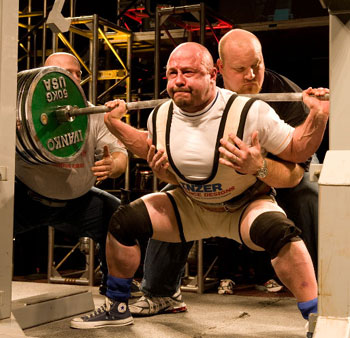
Sit your butt back like you are going to sit on the toilet, keep every muscle you have in your body tight and bend at the knees and hips. Keep the majority of the weight on your heels and lower the bar until your upper thighs are parallel to the floor. Don't sell yourself short. Squat deep at least to parallel of even lower if you can. If you can't hit parallel, you have too much weight on the bar. You need to take some weight off and try again.
Once you hit the bottom of the squat you need to push with all your might and get that bar back up. Drive through your heels and picture your hips being the driving force to get the bar up not your shoulders. Don't fear the squat
Squatting is a perfectly natural movement. If anybody tells you not to squat because it's bad for your knees has no idea what they're talking about. Anybody who tells you squatting below parallel is bad for your knees has no idea what they're talking about. Squatting properly has been proven to reinforce the lower body muscles alleviating a plethora of knee issues.
We were born to squat. Take a few minutes, go to google and type in baby squat. These are only the first few results. As you can see these children are squatting with perfect form. Feet flat, weight back on their heels backs straight. I believe it was the invention of modern footwear which has caused us to loose the ankle flexibility which at one time had us all doing perfect squats as children. But that's another rant altogether
So here is 2011. I hope everybody had a wonderful 2010 and a great time last night.
Now that the holidays are winding down and it's about time to get on with our lives I am looking forward to renewing my dedication to my blog and all things related to caveman fitness.
First off I'd like to revisit an older post on Fish oil and omega 3. I recently had an argument with a doctor who was filling in in the clinic where I work. I was attempting to explain to him how I believe that supplementing with high dose fish oil is just as effective at preventing heart attacks as aspirin. He laughed in my face and told me you can't save somebody from having a heart attack by having them suck on a mackerel. Not a very professional way to respond in front of my colleagues but a whole article is going to come from it so I suppose it could have been a good thing.
Us nutritional enthusiasts have a basic idea of all the good that comes from taking our Omega 3's. Heart heath, brain function, respiratory health lower blood triglycerides. Most of these contribute to a lower risk of heart attack but I'd like to visit the direct mechanism I'm here to talk about today.
First...
How aspirin prevents heart attacks
Aspirin is known as an anti platelet agent. Which means if prevents platelets from sticking together and forming a clot. Clots are a good thing because they stop you from bleeding if you cut yourself. The problem is that if a clot forms in side your blood vessles, they prevent blood from flowing to your tissues. In this case a clot forming or getting lodged in a coronary artery (an artery supplying blood to your heart) causes muscle death in your heart. This is a heart attack. Aspirin helps to prevent this clot from forming therefore reducing the chance of a blood clot being able to cause a blockage to major blood vessels.
Aspirin is used to prevent heart attacks in two ways. It is taken daily at low doses of 75mg/day. It this manner it reaches maximum effectiveness in about a week. This is used if the risk of heart attack is not immediate.
Taken in high doses of 325mg/day it reaches its maximum effectiveness in about 30 minutes. This is used when a heart attack is pretty much imminent. That's why if someone is having a heart attack and they call the paramedics, we give you 325mg aspirin before we even leave your house and make you chew it. EEEW!
How omega 3 oil helps to prevent heart attacks All the cells in our bodies are encased in a soft pliable layer called the cell membrane. Cell membranes are made up of fatty acids, therefore, all the fats we eat go into the makeup of these cell membranes. Further proof that fats are essential to proper functioning and need to be included in our daily diets.
Omega 3 fatty acids remain stable at room temperature, meaning they keep their liquid form. Most other fats tend to harden at room temperature. Since all our dietary fats go into the makeup of our cell membranes, Omega 3 fatty acids help to maintain the integrity and health of our cell membranes. This keeps them soft and pliable and able to do their jobs more efficiently. Also, in keeping them soft and pliable this prevents them from clumping together and allows them to flow freely throughout the bodies systems. In the blood this results in improved circulation and reduced clot formation. Not only reducing the risk of heart attack but also contributing greatly to cardiovascular and respiratory health as well, as blood cells can pass through capillary beds more freely resulting in increased oxygen transport as well.
Another look at the benefits of omega 3 Aside from reducing the risk of heart attack some other benefits of Omega 3 supplementation include but are not limited to
Brain function and concentration
Asthma
Arthritis
Inflammation
Increased VO2 max
Depression
Diabetes
Schizophrenia
Allergies
Blood Pressure
Blood Cholesterol levels
Eye Health
Some types of cancer such as breast cancer
Energy levels
Healthy pregnancies
Skin conditions such as psoriasis and eczema
It seems the health benefits of omega 3 supplementation reach close to all the bodies systems.
A Word of Caution People with difficulties clotting or who have bleeding problems should exercise caution when choosing to supplement with Omega 3. Also people who and on anticoagulants and vitamin K antagonists as their clotting factors are already inhibited
So I have to admit something here. I'm guilty of yet again doing what I warned about in my bodyfat article.
Doing the whole Intermittent fasting thing can be a wonderful tool but it can be really easy to take too far. If you want to be able to perform at your best you still need to get in enough whole food. It may be an amazing feeling to look in the mirror every week and see positive change. Just don't get carried away with what you see in the mirror.
My case may be a little bit different than what most people are after. If all you want is to be fit and healthy you can do a 16 hour fast every day and not notice and problems you will keep a healthy weight and have wonderful energy levels. Lots of people fast 16 - 18 hours and enjoy wonderful health improvements and energy levels. Those of us who strive to be elite athletes may have different energy requirements.
If you train like an elite athlete you already know your energy expenditure requires a considerable amount of calories to fuel For this I recommend backing off your fasts to one or two 16 - 18 hour fasts once or twice a week. I don't mean for the average person who spends 45 - 60 minutes in the gym three times a week. I mean for the serious athlete who trains at full intensity two hours a day five days a week.
For everybody though, I can't stress enough that you need to be able to listen to your body. Living the Caveman lifestlye is all about being in tough with what is happening in your body as well as your environment. Pay attention to what your body is telling you. If your abs are getting rock hard but your energy levels and mood are dropping, then back off on the fasting for a couple of days and allow youself to eat more.
Remember fasting is only a tool to be used for you benefit. It can be easy to get carried away. Use it to achieve and maintain your desired bodyweight but pace yourself and don't loose weight too quickly. The body needs to adjust to the composition changes.
Remember that it's almost impossible to have abs like you see on the cover of muscle and fitness. An impossibly low bodyfat level will only hinder athletic performance. If you look at the bodies of real atheletes you'll notice that they carry a little bit more bodyfat. It is needed to perform at the level of professional athletes.
So fast, just not everyday, and if you want to build muscle of perform at an elite level, then by god EAT!
It's a little bit late and I should be going to bed but I haven't done a post since arriving back at home and I have a few things I'd like to say.
Strong woman
You may have read my post about the type of exercise we do and the positive changes they will create in the human body. That was definitely not only intended for men to read. Strength is sexy and we should make sure we celebrate the beauty of strong women.
As is mentioned in the above video, it is sad that women can pick up a fitness magazine and be bombarded with images of emaciated women who obviously have no functional strength. Obviously weak, malnourished cardio junkies who have never lifted a real weight in their life. It is a bloody shame that women can be lead to believe that they should stick to stretching and avoid liftime real weights for fear that they will become "bulky" and have muscles like a man.
Strength in a woman is sexy. Lifting weights will not make a woman "bulky". On the contrary, Lifting heavy things develops the type of muscle that only accentuates a woman's natural curvature. It is impossible for a woman to "bulk up" with out the aid of certain "hormonal supplements". I have seen time and time again the results of women who aren't afraid to train hard and lift heavy and the results are nothing less that amazing.
I frequently include photos and videos of women doing impressive feats of strength and skill in my performance blog posts in the hopes of inspiring the girls who follow my workouts. To show them that strength and confidence are beautiful things. So are the women who possess them.


 The bar should track very close to your face. So close that you should just barely miss skinning your chin with the knurling in the center of the bar. As soon as the bar clears your head, push your head through so that the bar is in line with, or just behind your ears. Keep pushing up until you are fully locked out in the overhead position. That was a press