Thursday, June 30, 2011
CaveMan Babies Part one: The pregnancy
Wow it has been a long time since my last post. Much has happened since then so where do I begin...?
My wife and I have welcomed a wonderful new addition to our family on Friday June 17 at 3:49 pm. Her name is Gwendolynn and she is absolutely perfect. Which leads me on to today's topic. Paleo Pregnancy.
My wife Meghan and I have been following what we affectionately call the CaveMan2.0 lifestyle for over three years now. We have been eating very cleanly and exercising intensely the whole time and I feel I can say that Meghan firmly established a good solid fitness base before getting pregnant.
During her pregnancy Meghan made very few changes to her lifestyle. The first thing she did was to include whole milk back into her diet. She found she started craving it shortly after conceiving. She did start taking pre-natal vitamins and folic acid, on top of the vitamin D and omega 3 fish oil which she continued as usual.
We continued with our workouts the same as always at first, Meghan did switch to Crossfit mom or start scaling the workouts I prescribed after about six Months. She continued to do all her strength work but found she had to back off on the weight she lifted after about three months. As her belly grew she cut out moves like sit ups and handstand push ups, replacing them with dumbbell shoulder press and knees to elbows, but kept doing mostly the same movements all the way through.
The pregnancy itself was without any complications and I definitely do attribute this to our lifestyle. Megz did notice she felt more tired and didn't have quite as much go in the tank pretty much right away. it bothered that she couldn't hit the same weights on her strength moves but she kept going anyway and resolved to do what she could.
One interesting thing we noticed very early on is that Megz had to back off on our cheat meals. Usually we would be super strict on our diets all week and then the gloves would come off every Saturday night. Megz quickly discovered that she couldn't eat nearly as much sugar or processed carbohydrates. If she did she would most definitely be throwing it back up in a couple of hours. This is very interesting because she could still pack away as much healthy food as she wanted, but her body would reject that which we consider "cheat foods". Our Saturday night cheat meal was whittled down to about half as much or less. We didn't really mind because we knew it was her body taking care of the baby growing inside of her. So we resolved to reign in our cheat meals a little bit for the remainder of the pregnancy.
In the absolute latest stages of pregnancy Megz was definitely tired, she put on about thirty pounds and was feeling the difference. It was all in her breasts and belly though and didn't show any signs in her face or other areas until the last few weeks. She continued to work up to the last month and did notice some swelling of her feet only after being on them all day working retail.
She continued to go to the gym every chance she got. By the ninth month she was doing drastically reduced workouts but was still going and was still able to link together 5 pull ups. Mostly though, the last month was spent doing mobility and skill work with some supplemental strength work. She also spent a lot of time after her workouts hanging out in the bottom of the squat position, teaching those joints how to work in the position required. Megz was in the gym right up to two days before the birth of our Daughter. The only reason she missed the day before was because it was a scheduled rest day.
Doctor's check ups the entire time were pretty much textbook. Blood pressure remained perfect, heart rate remained perfect, blood sugars remained perfect. Baby was strong and seemed to be developing quite early in all respects. We found the heartbeat at 10 weeks and the doctor was amazed at how strong it was. Usually they won't check until 12 weeks but we were curious. I had to be at work for this so Meghan recorded it on her phone and messaged it to me. I was floored. it was incredible.
Doctor's appointments continued to be like this the entire time, at one point the doctor megz to "Lay off the sweets" as she couldn't understand why Megz seemed to put on almost all the baby weight at once. She pretty much put on all thirty pounds in the first six months and then leveled off and it was all out front. Then the Doc would check her out, find that everything was coming along perfectly and be satisfied that we don't eat sweets.
All in all I'd have to say that the pregnancy went as well as it could go. We definitely attribute it to being because Meghan is so fit. Gwendolynn developed perfectly and was two weeks ahead of schedule the whole time. There is no question in our minds that this was diet related. Little gwen had everything she needed to become strong and healthy in the womb and very little if anything that wasn't optimum
baby developing nutrition.
My next post will be on the labour and delivery. I originally wanted to put it all in one post but
a) it would have been too long, and;
b) Gwendolynn showed up in out lives two weeks ago and we haven't slept since so it was all I could do to get through an article this long.
Friday, April 29, 2011
What is wrong with this picture?
I'm sure her intentions are good but who can tell me what's wrong with this video? A free pound of bacon goes to the first person who can point out 3 problems with this video.
Sunday, April 24, 2011
Let's talk weaknesses
Well this was an interesting week. I barely had any time to train because I had to do Ruck Sack marches Tuesday and Thursday and I find if I go to the gym after rucking 10 - 12k with 50 pounds on my back I'm wasted the next day. The adrenals have finally succumbed to years of beating them down and I have to be really careful not to overdo it.
You may have noticed that I am just following the Crossfit.com WoD lately. I'll stick to that doing their workouts a day behind. The past year I have been so obsessed with strength that I would barely call what I have been doing CrossFit. It worked for a while but I find that my endurance while performing at a high intensity has suffered. True I have become stronger but to be completely honest, for the little bit of strength I have gained in my squat, I'm not sure if the trade off was worth it. Before leaving for Basic training two years ago I was making wonderful gains following the Main Site and I'm pretty sure I'd be just as strong today if I never followed a strength bias and just stuck to the main site and ate a ton of good food.
I'm going to follow the main site with a slight bias towards working on weaknesses. I am still going to dedicate a day every week to improving my squat as that is the single most important exercise there is to building total body strength. Also I am going to concentrate more on my particular weaknesses. Not spending time on my weaknesses was my undoing this open sectional. I attribute my mediocre performances not to lack of conditioning or strength, but to having one skill in most of the workouts that I have not developed. First it was double unders, then it was box jumps, and this week it was wall ball. I know what I have to work on for next year and i plan on going into the sectionals with no glaring weaknesses. It is frustrating being held back by being under developed in a particular skill when you have tons of gas in the tank. There were times on Saturday when I had no rep called three times in a row because my aim was terrible. This will not happen again.
All in all the sectionals have been a great learning experience so far. As frustrating as it has been I have learned that having a huge gas tank won't get you very far when you keep tripping on your rope or can't aim the wall ball. But it's ok. I know exactly what I have to do to become closer to the athlete I want to be. This was my first year competing next year will be completely different.
Saturday, April 16, 2011
Let's talk competition
![]() |
| Sometimes the judges and spectators can be the heaviest burden you'll have to bear |
CrossFit Games open Sectionals. WOD 11.4
Complete as many rounds in ten minutes as possible.
60 Face to bar burpees, each burpee starts facing a loaded barbell and finishes with a jump over the bar
30, 120lb overhead squats
10 muscle ups
Let's talk a little bit about competition.
As I have stated before, I have been doing the CrossFit Games Open Sectionals. Up until today I have been very disappointed with my performances. It seems as though I have been playing mind games with myself.
Every WOD up until today I have come out of it wondering why I couldn't push harder when I know I was capable. How come I haven't pushed as hard in competition as I do working out on my own?
I strongly feel that when you choose to compete in your sport, it becomes an entirely different beast altogether. You suddenly have a massive group of people all cheering for you who who all expect a performance from you. They know what you are capable of.
But they will all witness your shortcomings as well. The fear of letting them down can cause one to hold back. It can make you afraid to give it your all and suddenly crumble. So you hold back, because giving a strong performance somehow seems better that giving it your all and falling apart.
This is a tough hurdle to overcome. I think almost everybody we competes at any level has experienced the exact feeling I am talking about. Some call it fear of failure, some call it wrestling with your inner demons. It's that voice that says everybody here is going to see you fall apart and it is the loudest voice you will ever hear. The scary part is that not a single person in the arena can hear what it is saying to you. Seasoned veterans can see it in you though.
4 Weeks in, I was finally able to single that voice out in the crowd and tell it to shut up. I decided this morning that I was going to perform to my best. I voiced my my intent to the universe and turned out what is to me an incredible performance. one full round and 14 burpees. Sure I feel that I could have done better. Everybody feels that way after a WOD. But no matter what I placed on the leaderboard, my biggest victory was over myself.
Sunday, March 20, 2011
Strength Traiing for beginners part 3: The Press
Aaaaaaaah the press.
Otherwise known as the standing barbell press, military press or overhead press. No matter what you call it, it's bar none the best way to develop pushing strength in the human upper body. In recent years the bench press has taken over as the official benchmark of human pushing strength. This is because the bench places the upper body in a more stable position making it easier to judge in competition. If you want to build real upper body strength nothing will do it quite like the press.
Thankfully, of all the exercises described in this series, the press is the easiest to teach over the internet.
The stance
This part is largely up to you. You want your feet to be under your hips, from there play with width until you find something that is comfortable for you. Set the bar up on the rack to be about mid sternum height. When you pick up the bar you want your hips slightly tucked under just enough that you don't over arch your back. Keep your abs tight and your chest out and high kind of like as if you were walking along a beach full of ladies (or dudes if that's your thing).
Approach the bar
Step up to the bar. Grab the bar with some chalk on your hands. When you pick the bar up, you want it resting along the upper part of your chest, on your upper pectorals. Elbows should be pointed down and slightly out in front of the bar. You want your wrists to be relatively straight and not cocked back from the weight of the bar. When you press, you want the weight of the bar to be directly over your wrists. Letting the weight cock your hands back at the wrists is an unstable position. You won't be able to push as mush weight and you will get sore after a while.
Now Press
From this position, all you have to do is push the bar overhead. Be careful not to dip at all through the knees, this is called hip drive and effectively turns the move into a push press. In order to avoid hip drive while pressing, I like to lock my knees out before pressing, effectively making it impossible to add hip drive to the movement.
Now lower the bar back under control to your chest following the exact same path back down and repeat.
Sunday, March 6, 2011
Strength Training part II, The Power Clean
Well hello there.
It's sure been a while hasn't it. Once again I must apologize for my lack of updates but I have been on a personal protest against most forms of modern technology. Therefore I have been spending an absolute minimal amount of time on the internet. I've spent the past couple of weeks only logging on to post workouts on my other page, Caveman Performance.
Now let's get into it....
Today is part two of my three part series dedicated to the three lifts that should form the foundation of any strength program. Today we're going to cover the power clean. The Power Clean is definitely the most complicated of the movements I plan on covering in the series, but with a little practice and a bit of proper instruction anybody can learn it.
So why should we power clean?
The power clean is essential for developing the kind of explosive power that is essential to any and every athletic movement. All athletic movements originate in the hips and involve an explosive opening of the hip area. The Power clean trains exactly this movement and therefore translates to improved athletic performance in everything from an Olympic high jump to just being able to walk up the stairs on your own when your 90 years old.
First things first, Let's start at the ending
I find that the hardest part about teaching the Power Clean is having my student catch the bar in the proper rack position. People tend to think it's becase they lack wrist flexibility, but I beg to differ. It's more accurate to say it's because people don't trust their shoulders enouch to balance the bar so they try to catch it with a death grip.
Ok look, I'll show you what I mean..
The lady in this picture has a great rack position. Take a second to commit this to memory. In the finished position of a Power Clean, the bar is resting on the anterior deltoids (the front of the shoulders). The upper arms are perfectly parallel to the ground and the fingers are completely relaxed. This places minimal strain on the wrists.
The problem most people have here is not wrist flexibility. It's that they don't trust their own bodies yet and they think they can't balance the bar and that it's just going to fall off. However, if you have your upper arms properly parallel and the par is resting nicely on your shoulders, I promise the bar is not going anywhere. You don't need your hands at all here.
Get over it and trust your own body. I like to have clients pick the bar up in the rack position before learning the movement and hold it there to get comfortable and to help open up the wrists and shoulders.
Now look at this guy. He has a decent rack (teehee) However, notice the grip his hands have on the bar. He is exhibiting a good amount of wrist flexibility here but his death grip on the bar is preventing him from getting his elbows up to parallel. Not to take away from his skill level, I don't know him personally and he could very well be doing a workout that involves fast multiple reps. For the time being though, I want you to look at his grip and his upper arm angle and compare it to the girl in the above photo. Now think "open fingers, good elbows. Closed fingers, bad elbows"
You're going to have to allow your grip to open up right before the bar lands o your shoulders. Don't worry, you'll figure it out.
Now back to the beginning
Take a stance with the bar about an inch from your shins. Bend over and grab the bar in a similar manner as preparing for a deadlift. I prefer a more vertical torso when preparing to do a clean, similar to the good fellow in this photo.
Grab the barbell using the Hook Grip. Always Olympic lift with the hook grip! Now after you have properly secured the Hook Grip onto the bar, ease pressure into the bar by taking up the slack. Lift the bar off the ground sliding it up the shins until you get to about your knees. Once you pass your knees you have to jump as high as you. This is that explosive opening of the hips I was talking about. This is the area that makes or breaks a power clean. It is in that jump that gives the bar the velocity needed to travel up to chest height in order to be caught in the proper rack position.
Stand over a barbell that is just heavy enough that there is no way you could possibly just pick up and put on your shoulders using muscle alone. Now think "How the hell am I going to get that up here!?!"
Bend over, grab the bar and be aggressive.
It's sure been a while hasn't it. Once again I must apologize for my lack of updates but I have been on a personal protest against most forms of modern technology. Therefore I have been spending an absolute minimal amount of time on the internet. I've spent the past couple of weeks only logging on to post workouts on my other page, Caveman Performance.
Now let's get into it....
Today is part two of my three part series dedicated to the three lifts that should form the foundation of any strength program. Today we're going to cover the power clean. The Power Clean is definitely the most complicated of the movements I plan on covering in the series, but with a little practice and a bit of proper instruction anybody can learn it.
So why should we power clean?
The power clean is essential for developing the kind of explosive power that is essential to any and every athletic movement. All athletic movements originate in the hips and involve an explosive opening of the hip area. The Power clean trains exactly this movement and therefore translates to improved athletic performance in everything from an Olympic high jump to just being able to walk up the stairs on your own when your 90 years old.
First things first, Let's start at the ending
I find that the hardest part about teaching the Power Clean is having my student catch the bar in the proper rack position. People tend to think it's becase they lack wrist flexibility, but I beg to differ. It's more accurate to say it's because people don't trust their shoulders enouch to balance the bar so they try to catch it with a death grip.
Ok look, I'll show you what I mean..
The lady in this picture has a great rack position. Take a second to commit this to memory. In the finished position of a Power Clean, the bar is resting on the anterior deltoids (the front of the shoulders). The upper arms are perfectly parallel to the ground and the fingers are completely relaxed. This places minimal strain on the wrists.
The problem most people have here is not wrist flexibility. It's that they don't trust their own bodies yet and they think they can't balance the bar and that it's just going to fall off. However, if you have your upper arms properly parallel and the par is resting nicely on your shoulders, I promise the bar is not going anywhere. You don't need your hands at all here.
Get over it and trust your own body. I like to have clients pick the bar up in the rack position before learning the movement and hold it there to get comfortable and to help open up the wrists and shoulders.
Now look at this guy. He has a decent rack (teehee) However, notice the grip his hands have on the bar. He is exhibiting a good amount of wrist flexibility here but his death grip on the bar is preventing him from getting his elbows up to parallel. Not to take away from his skill level, I don't know him personally and he could very well be doing a workout that involves fast multiple reps. For the time being though, I want you to look at his grip and his upper arm angle and compare it to the girl in the above photo. Now think "open fingers, good elbows. Closed fingers, bad elbows"
You're going to have to allow your grip to open up right before the bar lands o your shoulders. Don't worry, you'll figure it out.
Now back to the beginning
Grab the barbell using the Hook Grip. Always Olympic lift with the hook grip! Now after you have properly secured the Hook Grip onto the bar, ease pressure into the bar by taking up the slack. Lift the bar off the ground sliding it up the shins until you get to about your knees. Once you pass your knees you have to jump as high as you. This is that explosive opening of the hips I was talking about. This is the area that makes or breaks a power clean. It is in that jump that gives the bar the velocity needed to travel up to chest height in order to be caught in the proper rack position.
Do the power shrug as you jump. Note in the above photo, in the middle position. As Nicole jumps she is also shrugging her shoulders as explosively as possible. The power shrug combines with the jump and get's Sh*t done.
Now think of your arms as ropes. We don't try to muscle up the bar at all with our arms. They should generally be relaxed during the entire time the bar is moving upward. The only time you need to be working your arms at all during this movement is once the bar gets up to chest height when you bring your elbows up as aggressively as possible in order to get them up to parallel and into the proper rack position.
Some tips to help your power clean.
- Start light, Use an empty bar or even a broomstick or PVC until you are comfortable with the movement
- Add weight. I know, it sounds like I am arguing with myself here, but don't be afraid to push yourself a bit. Once you have a general idea of what it feels like you have to start adding weight in order to understand what a proper power clean should feel like
- Aggression! Olympic lifts are all about being aggressive. The more angry you get at the bar, the higher it's going to go
- JUMP as high as you possibly can. It's all in the hips
- Keep the bar as close to your body during the whole movement as possible. The more the bar travels in a perfectly straight line the less effort it takes to get it up there.
- Arms stay relaxed, we don't use our biceps here.
- Power Shrug
- Hook Grip!
Stand over a barbell that is just heavy enough that there is no way you could possibly just pick up and put on your shoulders using muscle alone. Now think "How the hell am I going to get that up here!?!"
Bend over, grab the bar and be aggressive.
Sunday, January 23, 2011
Strength training for beginners: The Big Three
This will be the first post in a three part series about strength training for beginners.
If somebody were to come up to me and ask me what the three most important exercises they should learn if they were to embark on a strength program, I would answer without hesitation: Squat, Power clean and Press. In that particular order.
These three are the kings for developing a strong base and any young athlete or average Joe/Jane looking to get stronger without wasting their time should first become proficient with these movements before ever branching off to other movements or exercises. I know they can seem intimidating at first, but with a little practice and logical progression anybody can learn to do these movements safely and confidently.
So let's get to it shall we.
Part one: The squat
The Why
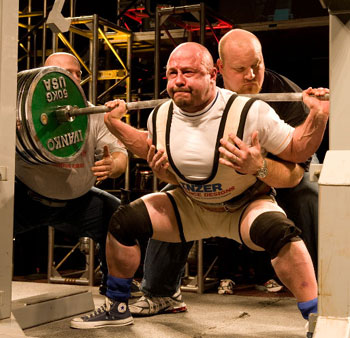
The squat on of the most natural movements to human bosy can do. Anybody who has ever sat down on the floor and then stood back up has done a squat. It is ingrained into our dna. Anybody who has seen a toddler get up from sitting ans most likely seen perfect squat form. Yet the squat has been haled by many as the "King of all exercises". It is true that no other exercise produces such dramatic results in such a short time as the squat. It involves every core and stability muscle in the body as well as all the large muscles in the lower body and forces you to work hard. It also elicits a neuroendocrine response like no other movement. This means that it tells the body to release hormones which make it get stronger.
When the body is worked as a whole it's hormone systems go into over-drive. It produces more testosterone and growth hormone in an attempt to adapt to the stresses you are putting it under. This is a great thing. It means more muscle, better recovery and it makes you stronger.
The How
Place a barbell in the squat rack about an inch below your shoulders. Stand below the bar with it resting on your shoulders. Some people prefer the high bar position with the bar resting on your upper traps. I personally opt for the low bar position with the bar resting on my rear delts.
Low bar position doesn't work the core quite as much but it is easier on your low back. I find it allows me to lift more with less chance of injury. If you go heavy, the you are still going to be getting a better ab workout than all the crunches you can do in a night anyway.
Stance it also a matter of personal preference. I'd recommend starting with your feet just outside your hips with your toes pointed slightly out. As you get comfortable and build strength you may want to play with this a little bit. I like to have my feet more shoulder with.
Once you have the bar where you like it and figure out where you are most comfortable placing your feet, take a deep breath into your abdomen, tighten your abs hard so support your core and lift the bar off the rack. Breathe out, breathe in, lock your abs.....
NOW SQUAT!
Sit your butt back like you are going to sit on the toilet, keep every muscle you have in your body tight and bend at the knees and hips. Keep the majority of the weight on your heels and lower the bar until your upper thighs are parallel to the floor. Don't sell yourself short. Squat deep at least to parallel of even lower if you can. If you can't hit parallel, you have too much weight on the bar. You need to take some weight off and try again.
Once you hit the bottom of the squat you need to push with all your might and get that bar back up. Drive through your heels and picture your hips being the driving force to get the bar up not your shoulders.
Don't fear the squat
Squatting is a perfectly natural movement. If anybody tells you not to squat because it's bad for your knees has no idea what they're talking about. Anybody who tells you squatting below parallel is bad for your knees has no idea what they're talking about. Squatting properly has been proven to reinforce the lower body muscles alleviating a plethora of knee issues.
We were born to squat. Take a few minutes, go to google and type in baby squat. These are only the first few results. As you can see these children are squatting with perfect form. Feet flat, weight back on their heels backs straight. I believe it was the invention of modern footwear which has caused us to loose the ankle flexibility which at one time had us all doing perfect squats as children. But that's another rant altogether
Take care!
If somebody were to come up to me and ask me what the three most important exercises they should learn if they were to embark on a strength program, I would answer without hesitation: Squat, Power clean and Press. In that particular order.
These three are the kings for developing a strong base and any young athlete or average Joe/Jane looking to get stronger without wasting their time should first become proficient with these movements before ever branching off to other movements or exercises. I know they can seem intimidating at first, but with a little practice and logical progression anybody can learn to do these movements safely and confidently.
So let's get to it shall we.
The Why
The squat on of the most natural movements to human bosy can do. Anybody who has ever sat down on the floor and then stood back up has done a squat. It is ingrained into our dna. Anybody who has seen a toddler get up from sitting ans most likely seen perfect squat form. Yet the squat has been haled by many as the "King of all exercises". It is true that no other exercise produces such dramatic results in such a short time as the squat. It involves every core and stability muscle in the body as well as all the large muscles in the lower body and forces you to work hard. It also elicits a neuroendocrine response like no other movement. This means that it tells the body to release hormones which make it get stronger.
When the body is worked as a whole it's hormone systems go into over-drive. It produces more testosterone and growth hormone in an attempt to adapt to the stresses you are putting it under. This is a great thing. It means more muscle, better recovery and it makes you stronger.
The How
| High bar position |
| Low bar position |
| Feet at hip width |
| Personally I prefer the wider stance |
NOW SQUAT!
Sit your butt back like you are going to sit on the toilet, keep every muscle you have in your body tight and bend at the knees and hips. Keep the majority of the weight on your heels and lower the bar until your upper thighs are parallel to the floor. Don't sell yourself short. Squat deep at least to parallel of even lower if you can. If you can't hit parallel, you have too much weight on the bar. You need to take some weight off and try again.
Once you hit the bottom of the squat you need to push with all your might and get that bar back up. Drive through your heels and picture your hips being the driving force to get the bar up not your shoulders.
Don't fear the squat
Squatting is a perfectly natural movement. If anybody tells you not to squat because it's bad for your knees has no idea what they're talking about. Anybody who tells you squatting below parallel is bad for your knees has no idea what they're talking about. Squatting properly has been proven to reinforce the lower body muscles alleviating a plethora of knee issues.
We were born to squat. Take a few minutes, go to google and type in baby squat. These are only the first few results. As you can see these children are squatting with perfect form. Feet flat, weight back on their heels backs straight. I believe it was the invention of modern footwear which has caused us to loose the ankle flexibility which at one time had us all doing perfect squats as children. But that's another rant altogetherTake care!
Subscribe to:
Posts (Atom)
Caveman2.0
!doctype>